Your Kitchen, Your Sanctuary: Simple Ways to Design a Space That Invites You to Slow Down
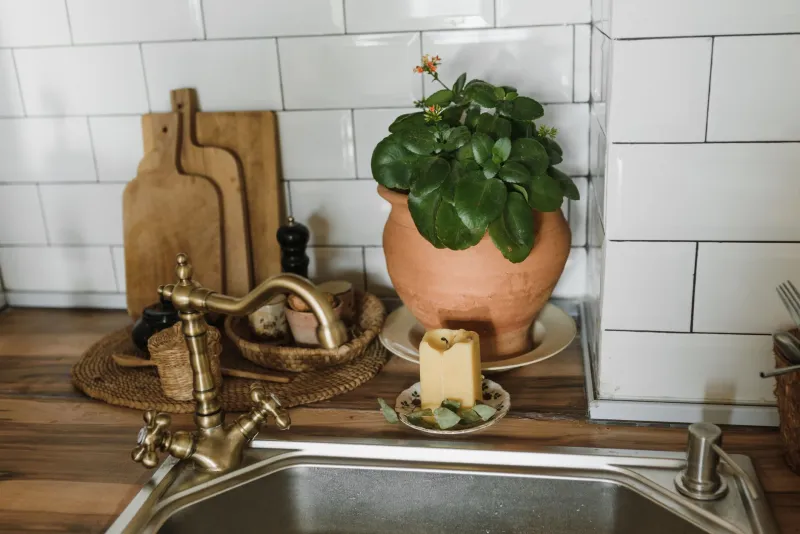
Most of us don't think twice about the way our kitchens are set up. The pasta goes where it fits. The good knife lives in the back of a crowded drawer. The overhead light buzzes at full brightness from the moment you start chopping onions to the moment you finally sit down to eat. It works, technically. But does it feel good?
There's a quieter question worth asking: what if your kitchen could actually help you slow down?
At Food Grace, we believe that cooking is one of the most grounding things a person can do — but only when we give it the space it deserves. The truth is, your physical environment has an enormous influence on how present you feel while preparing food. And with a few thoughtful adjustments, your kitchen can shift from a place you rush through to a place you genuinely want to be.
Start With What You Can See
Clutter is the enemy of calm. When every inch of counter space is occupied — mail stacked next to the cutting board, a blender that hasn't been used since last January, a fruit bowl overflowing with things you keep meaning to eat — your brain registers chaos before you've even picked up a spatula.
The first step isn't buying anything new. It's editing what's already there.
Take everything off your counters for one afternoon. Then, only return what you actually use several times a week. For most cooks, that's a cutting board, a knife block or magnetic strip, a kettle, and maybe a small dish of salt. Everything else finds a home inside a cabinet or drawer.
When your surfaces are clear, your mind follows. There's a reason professional cooks obsess over mise en place — the French concept of having everything in its place before you begin. It's not just efficiency. It's a mental cue that signals: we are present now. This is where we begin.
Let There Be (Softer) Light
Harsh overhead lighting does your kitchen no favors. It's the fluorescent equivalent of a to-do list — bright, demanding, clinical. Several home cooks we've spoken with across the US say that swapping out overhead fixtures for warmer bulbs, or adding a small lamp to a corner shelf, completely changed how they felt in their kitchens after dark.
Sarah, a home cook in Portland, Oregon, put it simply: "I used to dread making dinner because the kitchen felt like a task room. Then I added a little plug-in lamp near the stove and started keeping a candle on the windowsill. Now I actually look forward to it. The light makes it feel like a ritual instead of a chore."
Warm lighting — in the 2700K to 3000K range, if you want to get specific — mimics the golden-hour quality of late afternoon sun. It's softer on the eyes, easier on the nervous system, and it makes vegetables look beautiful, which doesn't hurt either.
Give Your Tools a Home Worth Returning To
Here's something worth considering: when your favorite tools are hard to find, you rush. You yank open drawers, shuffle through the mess, grab the first thing that works. When your tools are visible, accessible, and lovingly arranged, you slow down.
A simple wooden crock on the counter holding your most-used spoons and spatulas is both functional and grounding. A magnetic knife strip mounted at eye level turns your knives into something to be appreciated, not hunted for. Even something as small as keeping your measuring cups nested in a consistent spot creates a small pocket of order that the brain finds deeply satisfying.
Marcus, a home cook in Atlanta, Georgia, started treating his cast iron skillet like a piece of art after his grandmother passed it down to him. "I keep it on the stove even when I'm not using it. It reminds me why I cook. Every time I see it, I feel connected to something bigger than dinner."
That kind of intentionality is what transforms a kitchen from a utility room into a sacred space.
Engage Your Senses Before the First Chop
Designing a mindful kitchen isn't only about what you see. Sound, scent, and texture all contribute to how present you feel.
A small herb pot on the windowsill — basil, mint, rosemary — means you can brush your fingers over the leaves before you cook and breathe in something alive and fragrant. It's a two-second act that anchors you in the moment more effectively than any mindfulness app.
Some cooks keep a small Bluetooth speaker in the kitchen specifically for cooking playlists — not podcast episodes or true crime, but music that matches the pace they want to keep. Slow, intentional cooking pairs beautifully with jazz, folk, or even classical. Fast-paced pop is great for a Friday night with friends, but on a Tuesday when you're trying to actually taste your life, something quieter serves you better.
The Ritual of Setting Up
One of the most powerful shifts you can make costs absolutely nothing: treat the five minutes before you start cooking as part of the meal itself.
Wipe down your counter. Pull out only what you need. Set a glass of water beside your cutting board. Take three slow breaths. These small acts aren't time-wasters — they're invitations. They tell your nervous system that what's about to happen matters.
Denise, a home cook in Columbus, Ohio, calls this her "kitchen opening" — borrowing the term from the restaurant world. "I started doing it during the pandemic when I had nowhere to be. Now I can't imagine cooking without it. It's like stretching before a run. It just makes everything feel better."
You Don't Need a Renovation — You Need Intention
None of this requires a remodel, a bigger kitchen, or a budget for fancy cookware. The most mindful kitchens we've encountered aren't the most expensive ones. They're the ones where someone made deliberate choices about what to keep, how to arrange things, and what kind of atmosphere they wanted to cook inside of.
Gratitude, at its core, is a practice of noticing. And when your kitchen is designed to slow you down — even slightly — you start noticing more. The weight of a wooden spoon. The sound of onions softening. The way steam rises from a pot of soup on a cold evening.
That's the grace in the kitchen. It was always there. Sometimes you just need to clear a little space to feel it.