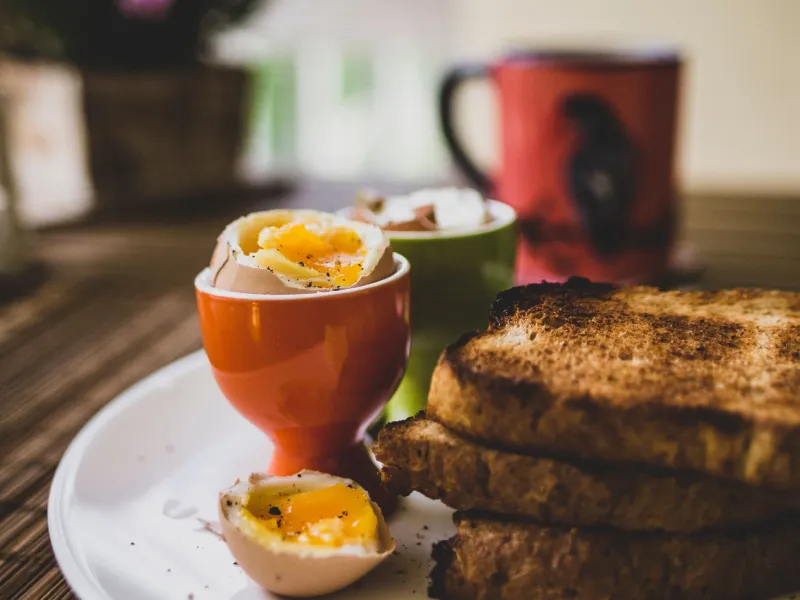
Somewhere between the alarm and the commute, breakfast became a transaction. A granola bar unwrapped in the car. A smoothie gulped over the sink. Coffee — always coffee — consumed while scrolling through whatever the night left behind in your notifications. We eat to fuel, not to feel. We eat to finish, not to begin.
But here's the thing about mornings: they're soft. Before the calendar fills up and the inbox gets loud, there's this small, quiet window where you're still a little bit unformed. Still deciding, in some cellular way, who you're going to be today. What if breakfast could live inside that window — not as a chore to check off, but as a ritual that actually shaped the hours ahead?
The Science of Starting Right (And Why It's Not About Protein)
Nutritional science will tell you plenty about what to eat in the morning. Protein. Fiber. Complex carbohydrates. Healthy fats. That conversation is real and worth having. But there's a parallel conversation that gets far less airtime: the how of eating breakfast, and what it does to your emotional baseline for the rest of the day.
Research in behavioral psychology consistently shows that how we begin a task — including a meal — sets a kind of emotional template. A rushed, distracted breakfast doesn't just leave you physically unsatisfied. It primes your nervous system for reactivity. It tells your brain, before you've even stepped outside, that there isn't enough time, that things need to be hurried through, that presence is a luxury you can't afford.
Contrast that with a breakfast eaten slowly, with attention — even for just fifteen minutes — and the signal changes. You've practiced patience. You've noticed something. You've given yourself the small but meaningful gift of existing in the moment before the moment got complicated.
What "Intentional" Actually Looks Like Before 8 A.M.
Let's be honest: the word intentional gets thrown around so much in wellness culture that it's started to feel like pressure dressed up as peace. So let's strip it back to something practical.
Intentional breakfast doesn't mean a perfectly styled açaí bowl photographed in golden hour light. It doesn't require a farmers market haul or a meditation cushion nearby. It just means making a few small decisions on purpose rather than on autopilot.
Start with one question the night before: What do I actually want to eat tomorrow morning? Not what's fastest. Not what you always have. What sounds genuinely good? That single act of forward intention — choosing your breakfast before the morning rush makes the choice for you — is a quiet form of self-respect.
Then, in the morning, try this: before you take your first bite, look at what's in front of you for a few seconds. Just notice it. The color of the yolk. The steam rising from the oatmeal. The way a sliced strawberry looks almost architectural when you actually pay attention. You're not performing gratitude here. You're just arriving.
The Ingredients as Conversation
One of the most underrated pleasures of cooking breakfast at home is that the ingredients tend to be simple and honest. Eggs. Bread. Fruit. Oats. Butter. These aren't complex pantry builds — they're foundational, familiar, and loaded with the kind of everyday beauty we tend to overlook.
When you slow down enough to notice where your food came from — the eggs from a local farm at the weekend market, the blueberries that are somehow still in season, the sourdough from the bakery two neighborhoods over — something shifts. You stop eating abstractions and start eating things. Real things, with origins and effort behind them.
This isn't about being precious or performative. It's about recognizing that the food on your plate represents a chain of care — farmers, truckers, grocers, maybe your own hands doing the cooking — and that acknowledging that chain, even briefly, changes your relationship to the meal. Gratitude doesn't have to be spoken out loud to be real.
A Simple Framework for a Morning That Feels Different
If you want to experiment with a more intentional breakfast practice, here's a loose framework that doesn't require a lifestyle overhaul:
The night before: Choose your breakfast. Pull out what you need. Set the table if that's your thing, even just a placemat and a real glass instead of a paper cup.
The morning of: Put your phone in another room for the duration of breakfast. This one is harder than it sounds and more powerful than you'd expect.
While you cook: Pay attention to the sensory details. The sound of butter in a pan. The smell of toast. These aren't distractions from your morning — they are your morning.
Before you eat: Take one breath. Not a meditation, not a ritual — just a breath. Let it mark the transition from rushing to receiving.
While you eat: Chew more than you think you need to. Put your fork down between bites occasionally. Notice what the food actually tastes like, not just that it tastes fine.
After: Sit for an extra minute before standing up. Ask yourself — honestly, without judgment — how you feel. Not how you should feel. How you actually feel.
The Question Breakfast Has Been Waiting to Ask You
Here's what all of this is really about: breakfast, eaten with any degree of presence, has a way of surfacing honesty. When you're not distracted, when you're not scrolling or half-watching the news, the morning gets quiet enough that you can hear yourself think. And sometimes what you hear is useful.
Am I dreading today, and why? Am I hungry in a way that has nothing to do with food? Is there something I'm grateful for right now, in this kitchen, with this cup of coffee, before anything has had a chance to go wrong?
These aren't heavy questions. They're just real ones. And the table — your table, on an ordinary Tuesday morning — is actually a pretty good place to ask them.
The meal doesn't have to be elaborate. The practice doesn't have to be perfect. But somewhere in the act of choosing to sit down, to eat slowly, to notice the food in front of you before the day takes over — there's a grace in that. A small, daily grace that compounds over time in ways that are hard to measure and genuinely hard to overstate.
Breakfast has always been there, waiting. Maybe it was always asking better questions. Maybe we just needed to slow down long enough to hear them.